The downloadable PDFs contain no browser-added date, time or website address. When printing this webpage in Chrome or Edge, open More settings and turn off Headers and footers.
Artwork is symbolic teaching illustration, not an archival photograph or a reconstruction of a named place. Dates, labels and explanations remain in the text. Print controls prepare the selected document's images and fonts before opening the print dialog.
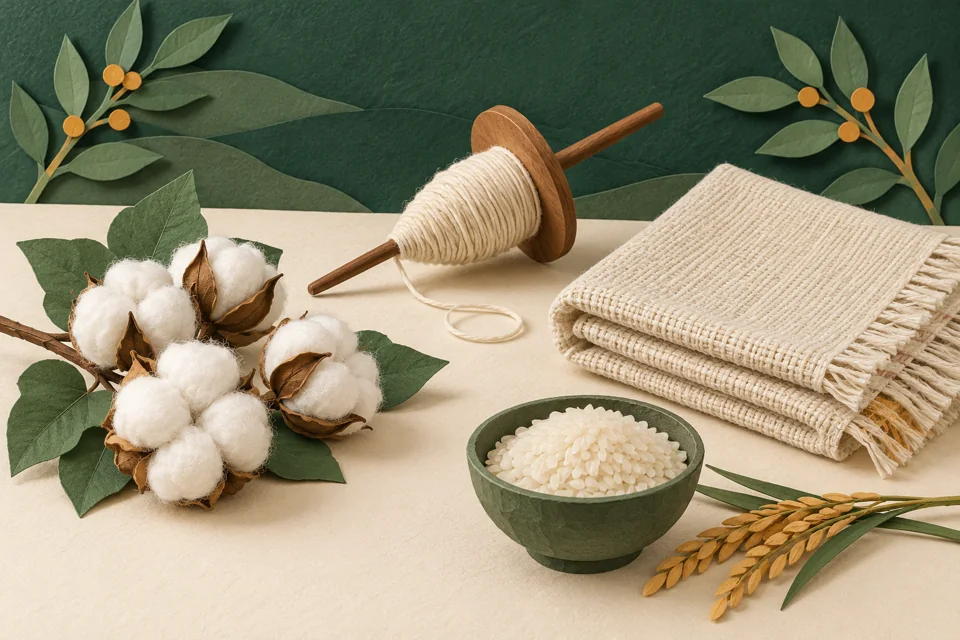
Raw cotton, yarn, cloth and food grain show different connections with farming.
Agriculture: food, materials and trade
Primary activity: cultivating crops produces food and biological raw materials.
Everyday needs: rice supplies food; cotton supplies fibre for textiles.
Trade: products such as tea, coffee and spices also connect agriculture with exports.
Different methods: soil, rainfall, technology and local practices influence how people farm.
Trace one material without skipping a stage
Cotton bolls
Agricultural raw material harvested from a plant.
spinning →
Yarn
Spinning turns the fibre into a continuous thread.
weaving →
Woven cloth
Weaving joins yarn into fabric.
Growing the cotton is agriculture; spinning and weaving process its raw material.
Rabi: wheat, gram, mustard and linseed. Kharif: paddy, maize, cotton and groundnut. Zaid: suitable short summer melons, cucumber and vegetables.
Regional cycles: Aus/Aman/Boro rice; Bihar rabi maize; sesame north kharif/south rabi; castor both. Almost-year-long cane does not fit a short summer gap.
Coffee: traditional Karnataka, Kerala and Tamil Nadu. Baba Budangiris is in Karnataka; Nilgiris is one region. Other regions also grow coffee.
Horticulture: warm-region mango/banana and temperate apple/pear/apricot/walnut, plus diverse vegetables. Fresh produce needs careful handling and timely access to buyers.
Cane: 21°C to 27°C, 75 to 100 cm rain or irrigation; long duration → sugar, gur, khandsari, molasses.
Oilseeds include groundnut, mustard, coconut, sesame, soybean, castor, cottonseed, linseed and sunflower. Uses include cooking and industrial products.
This format has not been prepared yet. Browser-menu printing uses text first, without blank illustration slots. For the prepared version, cancel and use the labelled Print notes control.
Study AnimatesClass 10 / Geography
Agriculture: Detailed notes
Visual notebook. Artwork is symbolic teaching illustration.
Agriculture
1. A farm connects many lives
Agriculture is a primary activity that produces food and raw materials while supporting livelihoods and trade.
Raw cotton, yarn, cloth and food grain show different connections with farming.
Agriculture: food, materials and trade
Primary activity: cultivating crops produces food and biological raw materials.
Everyday needs: rice supplies food; cotton supplies fibre for textiles.
Trade: products such as tea, coffee and spices also connect agriculture with exports.
Different methods: soil, rainfall, technology and local practices influence how people farm.
Trace one material without skipping a stage
Cotton bolls
Agricultural raw material harvested from a plant.
spinning →
Yarn
Spinning turns the fibre into a continuous thread.
weaving →
Woven cloth
Weaving joins yarn into fabric.
Growing the cotton is agriculture; spinning and weaving process its raw material.
Agriculture
2. Subsistence, intensity and land
Subsistence farming mainly meets household needs. Its methods vary with land, labour, environmental conditions and available inputs.
Left: cropped and regenerating patches. Right: one intensively cultivated fixed plot.
The textbook term for small-patch farming with simple tools and family/community labour, dependent on monsoon and natural soil fertility.
Intensive subsistence farming
High labour and inputs on limited fixed land under population pressure.
Shifting cultivation / slash-and-burn
Cleared vegetation is burned and ash adds nutrients. Cultivation later moves as fertility declines; the earlier patch rests fallow.
Two ways land is used through time
Movement and fallow
A patch is cultivated for household crops.
Cultivation later moves; the earlier patch rests.
Vegetation regrowth can support recovery during sufficient fallow.
Intensive fixed-plot cultivation
The same limited plot remains cultivated.
Family labour, irrigation and inputs are concentrated per area.
Household food remains the main purpose in this case.
Shifting cultivation involves movement and fallow. Intensive subsistence concentrates work on limited fixed land. These describe farming systems, not the worth of farming communities.
Why land pressure matters: inheritance may divide a holding into smaller shares. If households still depend on farming, they may concentrate labour and inputs to obtain more output from each share. Division does not automatically lengthen fallow or turn food into a market crop.
Agriculture
3. Commercial farms and plantations
Commercial farming produces mainly for the market. A plantation is a commercial system with a single main crop over a large area, closely connected to industry.
Fresh leaves, processed tea and a tea chest show different network stages.
1Purpose first, then production system
Commercial: Production mainly for the market, often with capital, improved seed, fertilisers, pesticides and irrigation.
Same crop, different purpose: The source contrasts commercial rice in Punjab/Haryana with subsistence contexts in Odisha.
Plantation: A large area usually specialises in one main crop, linking capital and labour with processing and transport.
2A plantation network
Cultivate and pick
Obtain the crop's raw material.
supplies
Process
Prepare it for its intended market.
depends on
Move and sell
Connect the processed material with buyers.
Tea, coffee, rubber, sugarcane, banana and other source examples do not imply identical methods or processing.
Agriculture
4. Three seasons, many local calendars
A cropping season links sowing, growing conditions and harvest. India's broad calendar has rabi, kharif and the shorter summer zaid season.
Three seasonal crop groups support, rather than replace, the coded calendar.
1Read the whole cycle
Rabi: Sow broadly October to December, harvest April to June. Wheat, barley, peas, gram and mustard are source examples.
Kharif: Sow with monsoon onset, harvest broadly September to October. Paddy, maize, jowar, bajra, tur, moong, urad, cotton, jute, groundnut and soybean are examples.
Zaid: Short summer interval between rabi and kharif, with melons, cucumber, vegetables and fodder where suitable water and duration permit.
Follow planting through growth to harvest
Crop / cycle
Jan
Feb
Mar
Apr
May
Jun
Jul
Aug
Sep
Oct
Nov
Dec
Wheat, rabi example
−Grow in Jan
−Grow in Feb
−Grow in Mar
◆Harvest in Apr
◆Harvest in May
◆Harvest in Jun
No stage shown in Jul
No stage shown in Aug
No stage shown in Sep
●Sow in Oct
●Sow in Nov
●Sow in Dec
Paddy, kharif example
No stage shown in Jan
No stage shown in Feb
No stage shown in Mar
No stage shown in Apr
No stage shown in May
●Sow in Jun
●Sow in Jul
−Grow in Aug
◆Harvest in Sep
◆Harvest in Oct
No stage shown in Nov
No stage shown in Dec
Short summer vegetables
No stage shown in Jan
No stage shown in Feb
●Sow in Mar
−Grow in Apr
◆Harvest in May
No stage shown in Jun
No stage shown in Jul
No stage shown in Aug
No stage shown in Sep
No stage shown in Oct
No stage shown in Nov
No stage shown in Dec
● Sowing · line Growing · ◆ Harvest. Broad teaching windows, with local variation.
Broad textbook windows. Kharif sowing follows the local monsoon. This is a teaching calendar, not a field-level advisory; regional cycles differ.
The source names several rice crop cycles in states such as Assam, West Bengal and Odisha.
Bihar maize
Maize is also grown in rabi here.
Cane
Almost a year of growth cannot be squeezed into a short summer gap.
Agriculture
5. Rice follows warmth and water
Rice is a major staple cereal associated with warm, humid conditions and dependable water during growth.
Rainfall and a canal are different water pathways to rice beds.
1Warmth and substantial moisture
Profile: Rice is associated with high humidity and temperature above 25°C; the source gives over 100 cm rain as a guide.
Water source: Irrigation can support rice where rainfall is lower, including Punjab, Haryana, western Uttar Pradesh and parts of Rajasthan.
Broad distribution: Northern and north-eastern plains, coastal lowlands and deltaic regions feature in the source.
Rice: labelled regional evidence
North ↑West ← · → East↓ South
North-west
Punjab, Haryana and western Uttar Pradesh
Canals and tube wells help rice cultivation where rainfall alone is lower.
East and north-east
Assam, West Bengal and nearby plains
Warmth and substantial moisture support rice-growing areas.
Coasts and deltas
Eastern and southern coastal lowlands
Low-lying and deltaic areas form part of the source's broad distribution.
Schematic regional comparison based on source text and rice map, PDF pages 3 to 5. Compass positions are approximate; this is not a boundary map or a claim that every field in a region grows rice.
2Read distribution at the right scale
The source map distinguishes major and minor areas. A regional pattern does not mean every field grows rice, establish an exclusive boundary or show a current production rank. Aus/Aman/Boro also preserve local calendar variation.
Agriculture
6. Wheat needs a different season
Wheat is a rabi cereal that benefits from a cool growing season and bright sunshine at ripening.
Young wheat and mature ears distinguish growing and harvest stages.
1Growth and maturity are different stages
Stage / factor
Source profile
Growing season
Cool conditions.
Ripening
Bright sunshine.
Rain guide
50 to 75 cm, with actual water supply considered.
Zones
Ganga-Satluj plains and the Deccan black-soil region.
Wheat: two broad source zones
North ↑West ← · → East↓ South
Northern plains
Ganga-Satluj plains
Punjab, Haryana and Uttar Pradesh are prominent examples; the source also names Bihar and Rajasthan.
Central and Deccan zone
Black-soil wheat-growing areas
Madhya Pradesh and the Deccan black-soil region are part of the source account.
Approximate labelled regional evidence from source PDF pages 5 to 6, including its wheat map. It is not a boundary map, exclusive crop-zone rule or current production ranking.
2Named source examples
Northern and central states: Punjab, Haryana, Uttar Pradesh, Madhya Pradesh, Bihar and Rajasthan are named.
Winter moisture: Western temperate cyclone precipitation can benefit the rabi crop.
Spatial meaning: A strong northern concentration is compatible with wheat elsewhere; it is not a north-only boundary.
Agriculture
7. Different grains fit different places
Jowar, bajra and ragi are nutritious millets. Maize is another cereal used for both human food and animal fodder.
Left to right: branched jowar, cylindrical bajra, finger-like ragi and a maize cob.
1Four grains, four useful clues
Grain
Soil, use or nutrition clue
Source examples
Jowar
Largely rain-fed, relatively moist growing areas.
Maharashtra, Karnataka, Andhra Pradesh and Madhya Pradesh.
Bajra
Sandy and shallow black soils.
Rajasthan, Uttar Pradesh, Maharashtra, Gujarat and Haryana.
Ragi
Dry regions, varied soils; calcium and iron.
Karnataka, Tamil Nadu and other named states.
Maize
21°C to 27°C; old alluvial soils; food and fodder.
Karnataka, Madhya Pradesh, Uttar Pradesh, Bihar, Andhra Pradesh and Telangana.
2A crop's broad season can have a regional exception
Maize is mainly kharif, with rabi cultivation in Bihar. Millet dry-region adaptation means relative suitability, not zero moisture or automatic success.
Agriculture
8. Pulses connect protein and soil
Pulses are leguminous crops valued for protein. Their symbiosis with root-nodule bacteria can add biologically fixed nitrogen to farming systems.
A pigeon pea specimen makes the root-nodule partnership visible.
1Food and field roles
Food: Pulses are an important protein source. Examples include tur/arhar, urad, moong, masur, peas and gram.
Growing pattern: Many need less moisture than rice and can survive drier conditions. Gram/peas/masur are broad rabi examples; tur/moong/urad are broad kharif examples, with local variation.
Source regions: Madhya Pradesh, Rajasthan, Maharashtra, Uttar Pradesh and Karnataka are important source examples.
The root partnership and the later soil pathway
PlantSupplies sugars and a habitat to bacterial partners.
Root-nodule bacteriaFix atmospheric nitrogen into compounds the plant can use.
Rotation and residuesCan support later soil nitrogen. Harvest removes nutrients; other nutrient needs remain.
The bacteria fix atmospheric nitrogen. The plant supplies sugars and habitat. Arhar also participates; residue return and harvest removal affect later benefit.
2Scientific correction: include arhar
The textbook excludes arhar in one soil-fertility sentence. Arhar/pigeon pea is a legume that can form nitrogen-fixing symbioses with root-nodule bacteria. Bacteria perform fixation; the plant supplies sugars and habitat. Benefits to a following crop depend on effective symbiosis, conditions, harvested nutrients and residue management.
Agriculture
9. Sugarcane is a long commitment
Sugarcane is a tropical and subtropical crop that links a long growing period to sugar and other processing industries.
Cane stalks and three products are separate outputs, not one four-step recipe.
1A long-duration warm crop
Environment: About 21°C to 27°C and 75 to 100 cm rainfall, or irrigation in lower-rainfall areas; a range of soils and substantial labour.
Time: Almost a year of field occupation must fit the plan.
Regions: Source examples include Uttar Pradesh, Maharashtra, Karnataka, Tamil Nadu, Andhra Pradesh, Bihar, Punjab and Haryana.
2One raw material, several products
Product
Relationship
Sugar
Processed sweetener from cane juice.
Gur and khandsari
Other cane-derived sweeteners.
Molasses
A cane-processing product with further uses.
3Do not turn a product group into a false sequence
Sugar, gur, khandsari and molasses are not four obligatory successive stages. A high price does not shorten the crop's growing period.
Agriculture
10. Oilseeds do not share one calendar
Oilseeds supply oils used in cooking and as industrial raw materials. Their growing seasons differ by crop and region.
Specimens show oilseed diversity; the table supplies their different timing.
Uses: Oils serve food and/or industrial uses such as soap, cosmetics and other products, depending on the oil.
Source examples: Groundnut includes Gujarat, Rajasthan and Tamil Nadu in the source account. The source's dated quantities and rankings are historical context, not live figures.
Agriculture
11. Beverage crops need a network
Tea and coffee are beverage crops whose quality and livelihoods depend on suitable growing conditions, skilled work and processing networks.
Tea foliage and coffee cherries/beans are distinct botanical specimens.
1Keep the beverage crops distinct
Crop
Growing / material evidence
Geographical examples
Tea
Warm moist frost-free conditions, frequent showers, deep fertile humus-rich well-drained soil; skilled labour and leaf processing.
Assam, Darjeeling/Jalpaiguri, Tamil Nadu and Kerala; other source states are also named.
Coffee
Coffee cherries/beans form a different material route from tea leaves.
Traditional Karnataka, Kerala and Tamil Nadu; other regions also grow coffee.
2Geography correction
Baba Budangiris is in Karnataka; Nilgiris is a separate coffee region, not a name for all southern coffee. This clarification follows Coffee Board regional information. The source's 2020 production/rank statements are not presented as today's facts.
3The tea leaf connection
Pick
Skilled selection and labour.
supplies
Process
Fresh leaves must connect with the processing unit.
connects to
Market
Processed tea is packed and moved to buyers.
Agriculture
12. Fruit and vegetables fit local climates
Horticulture includes the cultivation of fruits and vegetables. India's varied climates support both tropical and temperate crops.
Fruit, vegetables and a handling crate connect horticultural diversity with delivery.
1Match crops with source associations
Crop group
Examples and places
Mango
Maharashtra, Andhra Pradesh, Telangana, Uttar Pradesh and West Bengal.
Apples, pears, apricots and walnuts in Jammu and Kashmir and Himachal Pradesh.
2Vegetables and handling
Vegetables: Peas, cauliflower, onion, cabbage, tomato, brinjal and potato are source examples.
Freshness: Suitable growth must connect with careful harvest, sorting, packing and timely delivery.
Interpretation: A place where fruit is sold is not necessarily its growing region. Production/export totals in the source are dated context.
Agriculture
13. Rubber is an industrial crop
Natural rubber is an industrial raw material obtained as latex from rubber trees and processed into useful products.
Latex in a collection cup, a rubber sheet and a gasket are different stages.
1Keep the material stages visible
Tree latex
Collected biological raw material.
processing
Processed rubber
An intermediate material such as a sheet.
manufacture
Manufactured article
A tyre, gasket or other industrial product.
2Hot, humid and well supplied with water
Climate guide: Above 25°C and above 200 cm annual rainfall in the source profile.
Regions: Kerala, Tamil Nadu, Karnataka, Andaman and Nicobar Islands and Meghalaya's Garo hills are named examples.
Limit: The guide is not a complete field-suitability assessment or a current rank table.
Agriculture
14. Three plant fibres and an animal fibre
Cotton, jute and hemp are plant fibres. Natural silk is obtained from silkworm cocoons; rearing silkworms for silk is sericulture.
Cotton, jute, hemp and a silkworm cocoon beside mulberry food.
1Source before processing
Fibre
Biological source
Growing / use connection
Cotton
Plant bolls.
Kharif; six to eight months; warm, frost-free growth and suitable rain or irrigation; drier black-soil areas.
Jute
Plant stem fibre.
Warm fertile well-drained floodplains, renewed by floods; sacks, mats and rope.
Hemp
Plant stem fibre.
Another plant fibre named by the source.
Silk
Silkworm cocoon.
Animal-origin; mulberry leaves feed the silkworm.
Trace silk without skipping the animal
Mulberry leaves
Food supports the animal.
feeds →
Silkworm
Produces a cocoon.
produces →
Cocoon filament
The silk material is obtained from this animal-produced source.
2Two plant-fibre regions
Cotton: Source examples include Maharashtra, Gujarat, Madhya Pradesh, Karnataka, Andhra Pradesh, Telangana, Tamil Nadu, Punjab, Haryana and Uttar Pradesh. The source gives about 210 frost-free days.
Jute: West Bengal, Bihar, Assam, Odisha and Meghalaya are named. Jute is used for gunny bags, mats, ropes, yarn and carpets.
3Sericulture
Rearing silkworms for silk. Mulberry food does not make silk a plant fibre; manufacture does not change a material's biological origin.
Agriculture
15. Technology needs institutions
Technological reforms change production methods. Institutional reforms change land arrangements, access, cooperation and the rules or organisations supporting farmers.
The parcel comparison isolates arrangement; the input objects suggest a different reform dimension.
1Historical phases in the chapter
After Independence / First Five-Year Plan
Land reform, consolidation, cooperation and institutional change.
1960s and 1970s
Green Revolution crop technology and White Revolution dairy development.
1980s and 1990s
A wider package of technical and institutional support.
Sequence only. Spacing is schematic, not proportional to elapsed time.
Regroup parcels without changing total areas
Scattered holdings
A, B and C each own two separated parcels.
Consolidated holdings
Same owners and total areas; parcels are regrouped.
Each owner has the same two parcels' total area before and after. This isolates consolidation from redistribution.
2Two reform dimensions
Dimension
Examples
Question
Technology
Improved seed, irrigation, tools.
Can the household access and use the package?
Institutional arrangements
Tenure, consolidation and cooperation.
How are rights, holdings and access organised?
3Uneven results need a mechanism
The same seed does not imply the same access to water, credit or other resources. A pump does not automatically consolidate land, and consolidation is not the same as redistributing every owner's total area.
Agriculture
16. Support reduces risk, with limits
Farm support mechanisms address different problems: finance, crop loss, weather uncertainty and weak bargaining or price conditions.
Separate physical groups cue four different support functions.
1Choose a tool by the problem
Problem
Mechanism
Remaining issue
Inputs before harvest receipts
Credit.
Repayment, interest and access.
Specified crop loss
Insurance.
Coverage, eligibility and assessment.
Timing under uncertain weather
Forecast/advisory information.
Forecast uncertainty and field context.
Price and sale evidence
Price support and procurement mechanisms.
Announcement is distinct from delivery, acceptance and payment.
2Historical account, not live scheme advice
The chapter names Kisan Credit Card and personal accident insurance among historical measures. Current programme eligibility and terms are outside this source-grounded lesson. Support does not prove a guaranteed crop, purchase or profit.
Agriculture
17. Land donation and village reform
Bhoodan and Gramdan were historical initiatives associated with Vinoba Bhave to widen land access through voluntary donation and village-level reform.
Symbolic blank document, plot and village setting are not archival records.
1The historical mechanism
Person and episode: Vinoba Bhave and Pochampally in present-day Telangana are central to the source account.
Bhoodan: Voluntary land donation intended to widen access for landless households.
Gramdan: The voluntary initiative extended to a village-level idea.
Context: The source places these efforts alongside other attempts to improve rural land access.
2Do not skip implementation
Offer
An owner expresses a willingness to donate.
requires evidence of
Transfer and rights
Records and actual access establish implementation.
also needs
Productive use
Water, land quality, inputs and support still affect cultivation.
A historical offer is not proof of completed rights, and secure access is not proof of guaranteed income.
Agriculture
18. Choose with evidence and trade-offs
A suitable farming decision combines environmental evidence with crop duration, household needs, labour, finance, processing, markets and long-term resource limits.
Three field samples keep different crop profiles visible on one planning desk.
1A decision that can be checked
Question
Use specific evidence
Does the crop fit?
Soil, temperature, seasonal water and full duration.
Does the purpose fit?
Household food, market plans and labour.
Does the chain work?
Processing, handling, transport and buyers.
Can the household carry it?
Finance, costs, rights and risk.
2Explain and revise
Claim: Name the feasible option and the evidence that supports it.
Mechanism: Explain how the crop, input or institution addresses the actual constraint.
Trade-off: State one specific cost, risk or missing item of evidence.
Update: When the evidence changes, revisit the affected part of the plan.
3Scale and dates
A broad map is not a field survey, a source-year statistic is not a current rank and a support mechanism is not a guaranteed result. Useful caution must stay attached to actual crop knowledge rather than replace it.
Study AnimatesClass 10 / Geography
Agriculture / Quick notes 1 / 2
Seasons, systems and suitable crops
Environment + water
Crop duration + purpose
People + networks
A compact crop calendar
Crop / cycle
Jan
Feb
Mar
Apr
May
Jun
Jul
Aug
Sep
Oct
Nov
Dec
Wheat
−Grow in Jan
−Grow in Feb
−Grow in Mar
◆Harvest in Apr
◆Harvest in May
◆Harvest in Jun
No stage shown in Jul
No stage shown in Aug
No stage shown in Sep
●Sow in Oct
●Sow in Nov
●Sow in Dec
Paddy
No stage shown in Jan
No stage shown in Feb
No stage shown in Mar
No stage shown in Apr
No stage shown in May
●Sow in Jun
●Sow in Jul
−Grow in Aug
◆Harvest in Sep
◆Harvest in Oct
No stage shown in Nov
No stage shown in Dec
Vegetables
No stage shown in Jan
No stage shown in Feb
●Sow in Mar
−Grow in Apr
◆Harvest in May
No stage shown in Jun
No stage shown in Jul
No stage shown in Aug
No stage shown in Sep
No stage shown in Oct
No stage shown in Nov
No stage shown in Dec
● Sowing · line Growing · ◆ Harvest. Broad teaching windows, with local variation.
Broad examples: winter-sown wheat, monsoon-sown paddy and a short irrigated summer crop. Regional cycles vary.
Farming systems
Primitive subsistence: small patches, simple tools and household labour. Shifting/slash-and-burn: cultivation moves and earlier patches rest fallow.
Intensive subsistence: high labour and inputs on limited land. Commercial: mainly market production. Size alone does not define purpose.
Plantation: large area, one main crop, processing and transport links. The same crop can serve different purposes.
Add crops and regional exceptions
Rabi: wheat, gram, mustard and linseed. Kharif: paddy, maize, cotton and groundnut. Zaid: suitable short summer melons, cucumber and vegetables.
Regional cycles: Aus/Aman/Boro rice; Bihar rabi maize; sesame north kharif/south rabi; castor both. Almost-year-long cane does not fit a short summer gap.
Read the regional evidence
Rice: eastern/coastal plains and deltas, plus irrigated north-west. Wheat: Ganga-Satluj plains and Deccan black-soil zone.
Major/minor map areas show broad distribution, not exclusive crop boundaries, current ranks or each farm's income.
Compare the grains
Crop
Conditions and connection
Rice
Warm humid growth, above 25°C; above 100 cm rain or irrigation.
Wheat
Cool growth, sunny ripening; 50 to 75 cm rain guide.
Jowar
Largely rain-fed in relatively moist growing areas.
Bajra / ragi
Bajra: sandy/shallow black soils. Ragi: dry regions, varied soils, calcium and iron.
Maize
21°C to 27°C, old alluvial soils; food and fodder, seasons vary.
Pulses
Protein; many need less moisture. Gram/peas/masur often rabi; tur/moong/urad often kharif.
Soil is a process
Legume + root-nodule bacteria → nitrogen fixation → possible rotation benefit. Arhar also participates.
Benefits vary with conditions and residues. Harvest removes nutrients; rotation does not replace every nutrient input.
Coffee: traditional Karnataka, Kerala and Tamil Nadu. Baba Budangiris is in Karnataka; Nilgiris is one region. Other regions also grow coffee.
Horticulture: warm-region mango/banana and temperate apple/pear/apricot/walnut, plus diverse vegetables. Fresh produce needs careful handling and timely access to buyers.
Trace the materials
Material
Source and suitability
Rubber
Tree latex; hot humid conditions, above 25°C and above 200 cm rain guide → industrial goods.
Cotton
Plant fibre, kharif, 6 to 8 months; warm frost-free conditions, drier black soils, rain or irrigation.
Technology: seeds, irrigation, tools. Institutions: land reform, consolidation, cooperation and access.
Green Revolution: crop technology package. White Revolution/Operation Flood: dairy. Benefits can be uneven when supporting resources differ.
Cane and oils
Cane: 21°C to 27°C, 75 to 100 cm rain or irrigation; long duration → sugar, gur, khandsari, molasses.
Oilseeds include groundnut, mustard, coconut, sesame, soybean, castor, cottonseed, linseed and sunflower. Uses include cooking and industrial products.
Support with limits
Tool
Job and limit
Credit
Funds inputs; repayment and terms remain.
Insurance
Defined risks; coverage and assessment matter.
Weather advice
Informs timing; forecasts remain uncertain.
Price support
Benchmark and procurement mechanisms; not every crop from every farm is bought.
Land access
Vinoba Bhave's Bhoodan: voluntary land donation; Pochampally in Telangana is a key source episode. Gramdan extended the village-level idea.
An offer is not proof of completed rights or income. Land quality, water, resources and implementation matter.
Choose and qualify
Check soil, seasonal temperature, water and duration. Compare food, income, labour, finance and processing access.
Use broad maps to ask local questions. Compare feasible alternatives and name who bears cost and risk.
State uncertainty, protect future soil and water and review the plan when conditions change. No crop fits every farm.