The downloadable PDFs contain no browser-added date, time or website address. When printing this webpage in Chrome or Edge, open More settings and turn off Headers and footers.
Artwork is symbolic teaching illustration, not an archival photograph or a reconstruction of a named place. Dates, labels and explanations remain in the text. Print controls prepare the selected document's images and fonts before opening the print dialog.
Language shares in the textbook's Belgian example
Same community. A different population.
Belgium
Whole country
Dutch59%
French40%
German1%
Dutch speakers are the national majority.
Brussels
Capital city
Dutch20%
French80%
Dutch speakers are a minority in the capital.
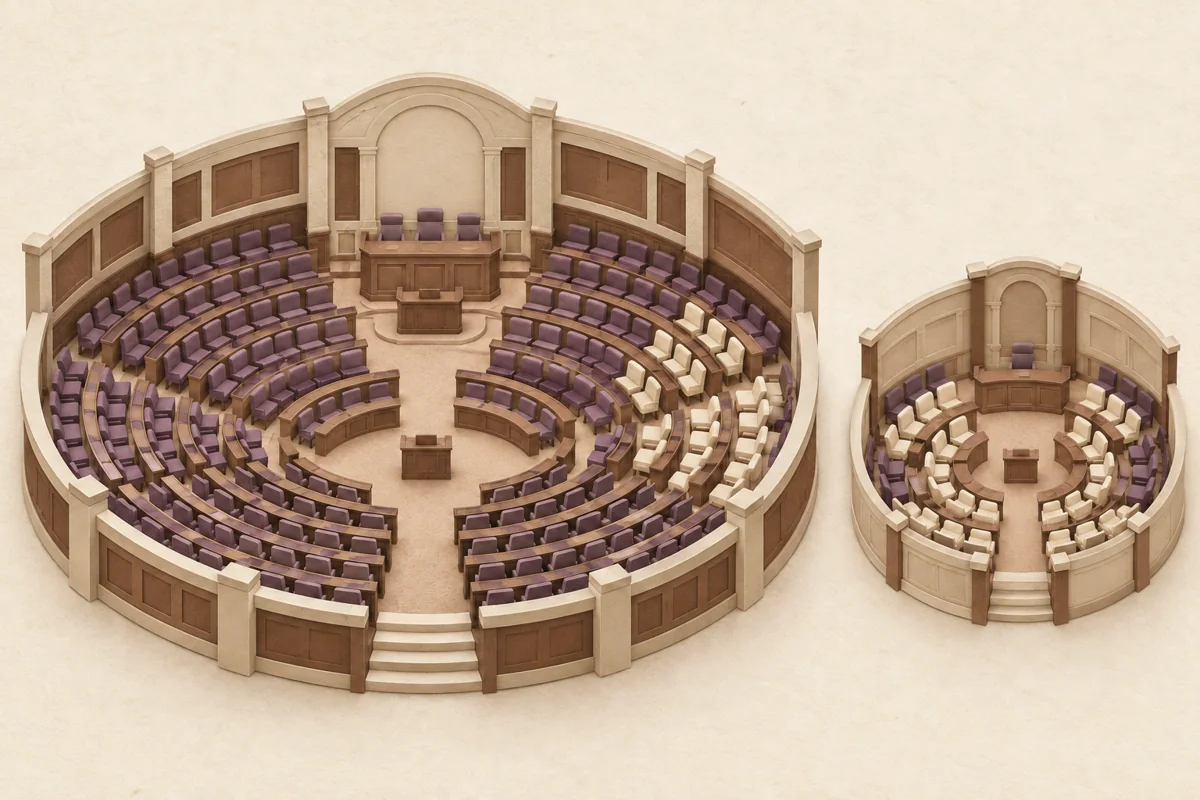
Symbolic chambers suggest different scales; the labelled bars give the actual textbook figures.
A majority is a relationship to a population. The national balance does not describe every city. These are textbook-context figures, not a current census.
1Numbers do not tell the whole story
Belgium's national Dutch-speaking majority becomes a minority in Brussels. A national percentage cannot be used as the city's percentage.
French speakers were relatively rich and powerful. Dutch speakers gained the benefits of economic development and education later. Unequal opportunity helped create tensions during the 1950s and 1960s.
The textbook places Dutch speakers mainly in the Flemish region and French speakers in Wallonia. Its maps show broad concentrations, not that every resident has the same identity.
Belgium borders France, the Netherlands, Germany and Luxembourg. Its textbook comparison with Haryana describes a smaller area and a little over one crore people; it is not a current population estimate.
2Sri Lanka: language is one classification
Sri Lanka is an island off southern India. The textbook gives about two crore people, comparable to Haryana in that context.
Language shares: Sinhala speakers are 74% and Tamil speakers 18% of the national population in the textbook.
Within the Tamil-speaking population: Sri Lankan Tamils account for 13% of the national population. The remaining Tamil share is described as Indian Tamils, whose ancestors came as plantation workers during colonial rule.
Sri Lankan Tamils are concentrated in the north and east on the source map. Concentration does not establish every individual's language.
3Religion overlaps language
Most Sinhala speakers are Buddhists. Most Tamils are Hindus or Muslims in the source account.
About 7% of the population are Christians, including both Sinhala and Tamil speakers. This is a religious share across language categories, not a missing language group.
Adding the Christian share to the language shares can double-count people. Use separate, clearly labelled comparisons rather than one combined pie chart.
4Ethnic identity is not one fixed religious label
Ethnic identity involves shared culture and beliefs about common descent. It need not coincide with one religion or nationality. Political choices about recognition and authority help explain how diversity is handled.
Diversity, political choices and democratic reasons
Historical context: 1948 independence
1956 Sinhala-only law
1970 to 1993 Belgian amendments
2009 Sri Lankan war ends
Belgium
Whole country
Dutch59%
French40%
German1%
Brussels
Capital city
Dutch20%
French80%
Participation is a right; stability is a possible benefit.
Read categories and scale
The bars compare the country with its capital. Dutch speakers change from national majority to city minority; economic and educational inequalities also shaped tensions.
Sri Lanka: Sinhala speakers 74%, Tamil speakers 18%; Sri Lankan Tamils 13% nationally. Indian Tamils descend from colonial plantation migrants.
Christians, about 7%, include Sinhala and Tamil speakers. Most Sinhala speakers are Buddhist; most Tamils Hindu or Muslim. Religion overlaps language, so do not add the figures.
These are textbook-context figures, not current measurements. Maps show concentrations, not every individual's identity.
Sinhala-only recognition, preferences in education/jobs and promotion of Buddhism privileged the majority. Majority votes do not erase equal rights.
Tamil parties sought language recognition, equality and regional autonomy. Repeated denial deepened distrust; by the 1980s some organisations sought a separate Tamil Eelam.
War caused deaths in both communities, displacement and lost livelihoods. Its 2009 end does not settle every grievance. Diversity did not make war inevitable.
Four amendments during 1970 to 1993 developed accommodation. Equal Dutch/French central ministers limit cabinet domination.
Some special laws require a majority within each linguistic group, not a veto over every decision. Brussels has equal representation for its two major language communities.
Regional governments have assigned powers and are not subordinate in this arrangement. Community government is elected by language members wherever they live, for culture, education and language.
Territory and community membership differ. Reciprocal safeguards helped avoid linguistic division; they are not a universal recipe or a promise of peace.
Prudential: expected practical benefits, such as less conflict or better administration. Moral: affected people have a right to participate.
One measure can have both reasons. In the panchayat passage, administrative gains are prudential; returning power to people expresses a democratic value.
Negotiation can take time. Small societies still need participation and limits on authority, even without visible group conflict.
Organs at one level ↔Governments across levels ↕Groups gain representationParties share, interests influence
Different roles can connect without becoming identical.
Horizontal: different organs
Legislature, executive and judiciary operate at one level with different functions. Ministers answer to representative chambers; courts can check laws and executive action.
Judicial appointment does not erase judicial checks. Balance does not mean identical jobs. The Bombay High Court order to Maharashtra officials is horizontal.
The 2005 Russia cartoon questions concentrated presidential power; it is an argument, not statistical proof.
Country-wide and regional governments have defined powers. India's terms are Union/Central and State; the principle extends to municipalities and panchayats.
A regional title or centrally assigned task alone does not establish meaningful authority. Coordination can coexist with distinct powers.
Nigerian state ministers asking about federal income and its distribution illustrate vertical accountability. The example gives no allocation formula or proven outcome.
Community government and representation safeguards can include otherwise excluded groups. Reserved constituencies are one example; the Ontario land settlement concerns government and a social community.
Rotation of a monitor may share opportunities; also examine decision authority, voice and accountability.
Party competition offers electoral choice. An alliance contests together; a coalition government shares governing office. Not every party system always forms a coalition.
The Russian common-list example is proposed electoral cooperation. Germany's 2005 example shows rivals governing together despite differences.
Pressure groups and movements can influence decisions or join committees without ministries. Farmers, workers and businesses may have different interests; influence is not guaranteed control.
Khalil's Lebanon story weighs community protection against individual eligibility and chosen identity. Consider wider opportunity alongside credible safeguards; permanent identity rules do not guarantee peace.
The Merchtem school-language ban must be judged by its effect on recognition, not only its stated integration aim.
Fictional town: combine language access, defined district powers, checks on the mayor and public consultation. Explain each purpose, a practical benefit, a participation right and a remaining trade-off.
This format has not been prepared yet. Browser-menu printing uses text first, without blank illustration slots. For the prepared version, cancel and use the labelled Print notes control.
Study AnimatesClass 10 / Civics
Power Sharing: Detailed notes
Visual notebook. Artwork is symbolic teaching illustration.
Power Sharing
1. One country, different community balances
Majority status depends on the population being compared; language and religion can overlap.
Language shares in the textbook's Belgian example
Same community. A different population.
Belgium
Whole country
Dutch59%
French40%
German1%
Dutch speakers are the national majority.
Brussels
Capital city
Dutch20%
French80%
Dutch speakers are a minority in the capital.
Symbolic chambers suggest different scales; the labelled bars give the actual textbook figures.
A majority is a relationship to a population. The national balance does not describe every city. These are textbook-context figures, not a current census.
1Numbers do not tell the whole story
Belgium's national Dutch-speaking majority becomes a minority in Brussels. A national percentage cannot be used as the city's percentage.
French speakers were relatively rich and powerful. Dutch speakers gained the benefits of economic development and education later. Unequal opportunity helped create tensions during the 1950s and 1960s.
The textbook places Dutch speakers mainly in the Flemish region and French speakers in Wallonia. Its maps show broad concentrations, not that every resident has the same identity.
Belgium borders France, the Netherlands, Germany and Luxembourg. Its textbook comparison with Haryana describes a smaller area and a little over one crore people; it is not a current population estimate.
2Sri Lanka: language is one classification
Sri Lanka is an island off southern India. The textbook gives about two crore people, comparable to Haryana in that context.
Language shares: Sinhala speakers are 74% and Tamil speakers 18% of the national population in the textbook.
Within the Tamil-speaking population: Sri Lankan Tamils account for 13% of the national population. The remaining Tamil share is described as Indian Tamils, whose ancestors came as plantation workers during colonial rule.
Sri Lankan Tamils are concentrated in the north and east on the source map. Concentration does not establish every individual's language.
3Religion overlaps language
Most Sinhala speakers are Buddhists. Most Tamils are Hindus or Muslims in the source account.
About 7% of the population are Christians, including both Sinhala and Tamil speakers. This is a religious share across language categories, not a missing language group.
Adding the Christian share to the language shares can double-count people. Use separate, clearly labelled comparisons rather than one combined pie chart.
4Ethnic identity is not one fixed religious label
Ethnic identity involves shared culture and beliefs about common descent. It need not coincide with one religion or nationality. Political choices about recognition and authority help explain how diversity is handled.
Power Sharing
2. When majority rule becomes domination
A majority's electoral strength does not justify unequal recognition or opportunity.
Sri Lanka: historical policies after independence
Follow the policy, then the grievance
1956
Sinhala-only official recognition
Tamil was disregarded in official-language recognition.
Unequal recognitionAccess to opportunity
Education and job preferences
Policies favoured Sinhala applicants for universities and government jobs.
Unequal opportunityConstitutional religious preference
Protection and promotion of Buddhism
The state privileged the majority religion in a diverse society.
Unequal state recognition
The unequal service lanes are symbolic. The policy labels name the historical choices in the textbook.
1
Exclusion
Policies deny equal recognition or opportunity.
2
Alienation and demands
Tamil parties seek equality, language recognition and autonomy.
3
Denied accommodation
Distrust deepens and conflict escalates.
This is a political explanation. Different languages do not themselves make war inevitable, and majority votes do not legitimise exclusion.
1A vote does not remove democratic obligations
Sri Lanka became independent in 1948. Elected governments then adopted policies that privileged the Sinhala majority.
Majority decision-making is a way to choose among alternatives. Decisions must still respect rights, equal opportunity and the participation of affected people.
Majoritarianism goes further: it claims that a majority community may rule as it wants while disregarding minority needs. An electoral victory does not justify that disregard.
2Demands changed as accommodation was denied
Sri Lankan Tamil parties sought official recognition of Tamil, equality in education and jobs and greater regional autonomy.
Autonomy means authority within the country. Repeated denial of provincial autonomy deepened alienation and distrust.
By the 1980s, several organisations demanded an independent Tamil Eelam in the north and east. A separate state differs from autonomy; do not assign every organisation one unchanging demand.
3An end to war is not an answer to every grievance
Distrust escalated into widespread conflict and civil war. Thousands from both communities died; families became refugees and many lost their livelihoods.
The war damaged social, cultural and economic life. The textbook states that it ended in 2009.
That ending does not by itself establish equal opportunity or resolve every grievance. Neither language difference nor one policy makes every later outcome inevitable.
Power Sharing
3. Belgium: safeguards at several scales
Different safeguards prevent domination in the cabinet, regions, capital and language communities.
Belgium: authority is shared through several arrangements
A safeguard for each scale of concern
Equal Dutch- and French-speaking ministers
Central cabinet
Prevents the national majority from monopolising the cabinet.
Meaningful assigned powers
Regional governments
State governments receive powers and are not subordinate in this arrangement.
Equal representation of both communities
Brussels government
Protects the Dutch-speaking minority in the French-majority capital.
Elected by language members wherever they live
Community government
Dutch, French and German communities have cultural, educational and language authority.
Language-community members across placeselect→Community government
Community governmenthas specified powers in→Culture, education and language
Connected learning spaces symbolise language membership across places. They are not actual Belgian buildings or a map.
Equal central ministers do not mean proportional representation everywhere. Some special laws need each linguistic group's majority; the scope is not every decision.
1A negotiated arrangement
Between 1970 and 1993, Belgium amended its constitution four times. Leaders recognised regional differences and cultural diversity rather than relying only on the national majority.
Dutch speakers accepted equal central representation; French speakers accepted equal representation in Brussels. Reciprocal safeguards answered different majority/minority balances.
Some special laws need a majority among members of each linguistic group. This requirement concerns specified laws, not a blanket veto over every government decision.
2Territory and community are different bases
Government
Who or what defines its scope?
Why it matters
Regional state government
A territory with assigned powers.
Regional authority is meaningful; these governments are not subordinate to the centre in the arrangement.
Community government
Dutch-, French- or German-language membership, wherever members live.
The community elects a body for cultural, educational and language matters across places.
3School language makes the distinction concrete
The textbook compares French-medium requests in a Belgian school with Tamil-medium requests under Sri Lanka's historical policies.
Belgium's community arrangements offer an institutional route for language interests. This helps explain why the Belgian request has a more responsive setting; it does not promise approval of every request.
Bilingual street signs illustrate public recognition. The European Parliament photograph shows an EU institution in Brussels, not the community government.
4A useful example, not a universal recipe
The textbook reports that accommodation helped avoid civic strife and a possible linguistic division. Every country need not copy Belgium's cabinet formula, and power sharing cannot guarantee peace.
Power Sharing
4. Two reasons, one democratic commitment
Sharing power can improve outcomes and is also valuable because participation is a democratic right.
A fictional council consults people about a water plan
One measure can have two justifications
What practical benefit might follow ?
Prudential
Local knowledge may improve the plan and reduce unresolved disputes.
Judge expected outcomes, gains and costs.
Why should people have a voice ?
Moral
Residents live with the decision's effects and deserve a role in shaping it.
Participation is valuable in itself.
Two symbolic paths meet at a shared table: expected practical gains and participation as a right.
Possible efficiency does not make domination morally acceptable. Participation can remain a right even when consultation takes time or produces no immediate saving.
1Judge the justification, not just the policy
Prudential reasoning weighs expected gains and losses. Sharing power can reduce the possibility of social conflict and political instability.
Majority domination may look convenient in the short run yet damage national unity over time. Its costs can harm the majority as well as minorities.
Moral reasoning values democratic participation itself. People affected by a decision have a right to be consulted about how they are governed.
These reasons can support the same policy. A missing cost saving does not automatically defeat a participation-rights argument.
2One passage can contain both reasons
The panchayat exercise values returning power to people: a democratic principle.
It also claims that local oversight can reduce corruption and improve administration: expected practical gains.
Keep the justifications separate when explaining them. The passage argues for benefits; it does not prove that every local decision is efficient or free from corruption.
3Sharing also matters beyond divided societies
Small societies and societies without strong linguistic division still need participation and checks on concentrated authority.
The German coalition cartoon concerns the 2005 election. Neither major rival secured a clear majority alone, so they governed together despite policy differences.
Negotiation can take time. Disagreement does not automatically mean sharing has failed, just as cooperation does not guarantee unanimous decisions.
Power Sharing
5. Different functions, visible checks
Separate institutions limit unlimited authority through distinct functions and checks.
Horizontal sharing: organs at the same governmental level
Different jobs. Limits on each other's power.
Make laws
Legislature
Debates and passes laws through representative institutions.
Ministers answer to Parliament or State Assemblies.
Administer
Executive
Ministers and officials put policies and laws into effect.
Executive action remains open to accountability and legal checks.
Review legality
Judiciary
Interprets law and can check executive action and legislation.
A legal check does not make the court the author of every policy.
Executiveanswers to→Parliament / State Assembly
Judiciarycan review→Executive action and laws
Symbolic civic buildings. Their equal position shows one level, not identical functions or an actual institutional layout.
Checks and balances limit unlimited authority. Appointment of judges by the executive does not erase their checking role.
1A worked judicial check
The Bombay High Court example concerns an order to Maharashtra officials to improve conditions in children's homes.
The actors are judiciary and executive. A state name does not turn this into a national-versus-regional relationship.
The court checks official action through its legal role. This does not make it responsible for running every government programme.
2Accountability is different from taking over
Fictional example: an assembly asks an agency to explain spending. Scrutinising a budget holds the executive accountable; it is not the same as administering the programme.
Different functions make responsibility clearer. Checks matter because separate institutions should not be able to exercise unlimited authority.
The 2005 Russia cartoon questions the concentration of presidential power. A critical cartoon is an argument to interpret, not statistical proof about every result of a government.
3Horizontal describes a relationship
The organs operate at the same governmental level. They need not have equal numbers of members, identical powers or agreement on every issue. Their different functions and checks are what matter.
Power Sharing
6. Authority across country, region and locality
Governments at different territorial levels need defined powers and meaningful accountability.
Vertical sharing: governmental levels, rather than organs at one level
Different territories. Defined authority.
Country-wide level in India
Union / Central Government
Government for the whole country.
Regional level in India
State Governments
Governments for regions, with powers defined in the constitutional arrangement.
Local levels
Municipalities / panchayats
The same sharing principle can extend to towns and villages.
Connected civic spaces are symbolic. Distance and size do not measure legal superiority.
The constitution defines powers across levels. Coordination is compatible with distinct authority; vertical sharing is more than a central office giving routine instructions.
1Defined authority is more than a regional name
A constitution can lay down powers for governments at different levels. This is a federal division of power.
A branch that merely carries out centrally assigned tasks has not necessarily received an established share of authority. Ask what rule assigns powers and limits interference.
Not every country has provincial or state governments. Different countries use different terms and arrangements.
2Resources help make powers meaningful
The Nigerian example describes state finance ministers asking about federal income and the formula for distributing revenue to states.
The relationship is between governmental levels, so it is vertical. Information and resources help governments plan and hold one another accountable.
The example does not supply the actual formula, show that the demand succeeded or establish current Nigerian practice.
3Coordination does not erase different powers
Union, State and local bodies can cooperate while exercising distinct responsibilities. A court checking state officials is a different relationship, usually horizontal. Regional autonomy within a country also differs from independence as a separate state.
Power Sharing
7. Representation, competition and public influence
Groups may gain representation, parties may share office and organised interests may influence decisions.
Several routes connect people to public decisions
Representation, office and influence are different
Social-group safeguards
Community institutions or representation arrangements include groups that might otherwise be excluded.
→Representative space
Party competition
Citizens choose among contenders with different programmes and social bases.
→Electoral choice
Coalition government
Two or more parties govern together while retaining differences.
→Shared governing office
Pressure groups and movements
Organised interests use committees or public action to affect policy.
→Influence without necessarily holding office
The negotiation table and public petition are symbolic. They do not depict real party identities or an official voting procedure.
An electoral alliance proposes cooperation in contesting. A governing coalition shares office. Influence on a decision is not a reserved ministry or guaranteed control.
1Representation can address exclusion
Religious and linguistic groups may receive institutional space. Belgium's community government is one example.
Legal and constitutional arrangements can represent socially weaker sections and women in legislatures and administration. The textbook recalls reserved constituencies in Indian assemblies and Parliament.
The Ontario land-claim settlement concerns accommodation of an aboriginal community. Its central relationship is government and a social community, rather than two countries.
2Competition and cooperation are different routes
Party competition lets citizens choose among contenders with different ideologies and social bases. It prevents one holder of power from being the only available choice.
Parties may form an alliance to contest together. The Russian example proposes a common candidate list; it does not establish that the parties already shared ministries.
A coalition government shares governing office between parties. The parties can negotiate policy while retaining their differences. Not every party system always produces a coalition.
3Influence does not require a ministry
Traders, business groups, farmers and industrial workers can organise interests, take part in committees or influence policy through public action.
A pressure group can be heard without holding government office. Influence does not give it guaranteed control over the final decision.
Changing the class monitor each month may distribute opportunities. To judge meaningful sharing, also examine who sets rules, whose voice counts and how authority is checked.
Power Sharing
8. Design a democracy that can hold together
A democratic design needs several mechanisms, evidence and honest attention to trade-offs.
A civic judgement explains more than the category name
Compare the case, mechanism, reason and limit
CaseMechanism and reasonLimit to consider
Khalil's dilemma
Social-group safeguards
Community-linked offices can protect trust after conflict.
Limit: A safeguard can restrict individual eligibility and chosen identity.
Merchtem school-language ban
Recognition and participation
An integration aim must be assessed alongside the effect on language recognition.
Limit: A stated common purpose does not justify every exclusion.
Fictional town design
Several complementary mechanisms
Use lawful checks, defined district powers and meaningful language access.
Limit: Negotiation takes time; no design guarantees every demand.
The civic modules are symbolic design materials. No single complete or perfect constitution is pictured.
Explain who gains voice or authority, why the mechanism matters and which limit remains. Weigh practical effects and participation rights rather than assume one perfect rule.
1Khalil's dilemma: protection and opportunity
The textbook's Lebanon discussion story describes community-linked offices: a Maronite Christian president, Sunni Muslim prime minister, Orthodox Christian deputy prime minister and Shi'a Muslim speaker.
The settlement also includes commitments against seeking French protection or unification with Syria. The story says the original demographic balance later changed.
Khalil has an Orthodox Christian father and a Sunni Muslim mother, but does not wish to adopt either identity. Community-based eligibility restricts his ambition for the top office.
His elders fear a return to civil-war losses. A reasoned reform must consider credible group protections alongside wider individual opportunity. Their assurance of peace is an attributed claim, not a guarantee.
2Assess a rule by its effect as well as its aim
The Merchtem school exercise describes a mayor defending a ban on speaking French as integration.
A common-purpose claim does not settle whether a rule respects language recognition and participation. The effect of the ban can conflict with accommodation.
Fictional town example: language access, defined district powers, lawful checks on a mayor and open public consultation can address different problems together. Each needs a clear purpose and limit.
3Make a qualified civic judgement
Name who shares or influences power, explain the mechanism and connect evidence to a reason. Slower negotiation is a real trade-off, but efficiency alone does not justify excluding people. No single arrangement guarantees peace, equality or acceptance of every demand.
Study AnimatesClass 10 / Civics
Power Sharing / Quick notes 1 / 2
Diversity, political choices and democratic reasons
Historical context: 1948 independence
1956 Sinhala-only law
1970 to 1993 Belgian amendments
2009 Sri Lankan war ends
Belgium
Whole country
Dutch59%
French40%
German1%
Brussels
Capital city
Dutch20%
French80%
Participation is a right; stability is a possible benefit.
Read categories and scale
The bars compare the country with its capital. Dutch speakers change from national majority to city minority; economic and educational inequalities also shaped tensions.
Sri Lanka: Sinhala speakers 74%, Tamil speakers 18%; Sri Lankan Tamils 13% nationally. Indian Tamils descend from colonial plantation migrants.
Christians, about 7%, include Sinhala and Tamil speakers. Most Sinhala speakers are Buddhist; most Tamils Hindu or Muslim. Religion overlaps language, so do not add the figures.
These are textbook-context figures, not current measurements. Maps show concentrations, not every individual's identity.
Sri Lanka: policy, grievance, response
Sinhala-only recognition, preferences in education/jobs and promotion of Buddhism privileged the majority. Majority votes do not erase equal rights.
Tamil parties sought language recognition, equality and regional autonomy. Repeated denial deepened distrust; by the 1980s some organisations sought a separate Tamil Eelam.
War caused deaths in both communities, displacement and lost livelihoods. Its 2009 end does not settle every grievance. Diversity did not make war inevitable.
Belgium: different safeguards
Four amendments during 1970 to 1993 developed accommodation. Equal Dutch/French central ministers limit cabinet domination.
Some special laws require a majority within each linguistic group, not a veto over every decision. Brussels has equal representation for its two major language communities.
Regional governments have assigned powers and are not subordinate in this arrangement. Community government is elected by language members wherever they live, for culture, education and language.
Territory and community membership differ. Reciprocal safeguards helped avoid linguistic division; they are not a universal recipe or a promise of peace.
Two reasons for sharing
Prudential: expected practical benefits, such as less conflict or better administration. Moral: affected people have a right to participate.
One measure can have both reasons. In the panchayat passage, administrative gains are prudential; returning power to people expresses a democratic value.
Negotiation can take time. Small societies still need participation and limits on authority, even without visible group conflict.
Study AnimatesClass 10 / Civics
Power Sharing / Quick notes 2 / 2
Four forms, practical checks and civic judgement
Identify the actors
Explain the mechanism
Give a reason
Use evidence
State a limit
Organs at one level ↔Governments across levels ↕Groups gain representationParties share, interests influence
Different roles can connect without becoming identical.
Horizontal: different organs
Legislature, executive and judiciary operate at one level with different functions. Ministers answer to representative chambers; courts can check laws and executive action.
Judicial appointment does not erase judicial checks. Balance does not mean identical jobs. The Bombay High Court order to Maharashtra officials is horizontal.
The 2005 Russia cartoon questions concentrated presidential power; it is an argument, not statistical proof.
Vertical: different levels
Country-wide and regional governments have defined powers. India's terms are Union/Central and State; the principle extends to municipalities and panchayats.
A regional title or centrally assigned task alone does not establish meaningful authority. Coordination can coexist with distinct powers.
Nigerian state ministers asking about federal income and its distribution illustrate vertical accountability. The example gives no allocation formula or proven outcome.
Social groups: meaningful representation
Community government and representation safeguards can include otherwise excluded groups. Reserved constituencies are one example; the Ontario land settlement concerns government and a social community.
Rotation of a monitor may share opportunities; also examine decision authority, voice and accountability.
Political actors: office and influence
Party competition offers electoral choice. An alliance contests together; a coalition government shares governing office. Not every party system always forms a coalition.
The Russian common-list example is proposed electoral cooperation. Germany's 2005 example shows rivals governing together despite differences.
Pressure groups and movements can influence decisions or join committees without ministries. Farmers, workers and businesses may have different interests; influence is not guaranteed control.
Compare a case, reason and limit
Khalil's Lebanon story weighs community protection against individual eligibility and chosen identity. Consider wider opportunity alongside credible safeguards; permanent identity rules do not guarantee peace.
The Merchtem school-language ban must be judged by its effect on recognition, not only its stated integration aim.
Fictional town: combine language access, defined district powers, checks on the mayor and public consultation. Explain each purpose, a practical benefit, a participation right and a remaining trade-off.